Services
LoRaWAN Survey
How LEVER's unique, patent-pending LoRaWAN survey capabilities define the new industry standard for LoRaWAN networks
Professional LoRaWAN Site Survey, Testing, Troubleshooting and Validation
LEVER provides industry-leading LoRaWAN Site Survey services using real-world RF measurements and cutting-edge survey techniques to design reliable, resilient, high-performance, cost-effective LoRaWAN networks.
Our LoRaWAN surveys employ highly innovative tools and techniques to optimise gateway locations, validate coverage, guarantee network resilience and ensure that your LoRaWAN network performs to the standards you require.
LEVER’s unique, proprietary, patent-pending LoRaWAN survey tools and techniques capture vastly-richer coverage data compared to conventional LoRaWAN surveys and test methods.
Benefits of a LEVER LoRaWAN Survey
LEVER’s new LoRaWAN Survey solutions mean that your LoRaWAN network will be designed to new standards, giving you peace of mind that your LoRaWAN network will perform as required – and at lower cost.
- Your LoRaWAN network – designed to new industry standards
- Complete vendor-independence
- High visibility and confidence in your LoRaWAN network design
- Higher network performance and reliability
- Cost reduction – cut your OpEx costs and potentially your CapEx too
- Heightened Security – through our LoRaWAN Security Policies and Audits
- Peace of mind in your chosen solution.
Why do you Need a LoRaWAN Survey?
With its substantial Link Budget, LoRaWAN can potentially support communications over long distances. It can also provide “coverage” in buildings where other wireless technologies cannot. However claims such as these can create a false sense of security.
Most LoRaWAN testing and surveying today involves testing the reachability of a gateway using a LoRaWAN test device. But this type of simplistic testing – verifying that a LoRaWAN packet can reach a gateway – does not mean that the network being designed has sufficient:
- RF link margin
- gateway diversity
- network resilience
- uplink reliability
- downlink reliability
- coverage in difficult locations
- network capacity to meet your needs.
Buildings, terrain, machinery and other physical obstructions all impact LoRaWAN signal propagation.
Basements, plant rooms, service tunnels, reinforced concrete structures, steel-framed buildings and metal equipment can be particularly challenging — and these are often precisely the locations where IoT sensors need to operate.
LEVER’s industry-leading LoRaWAN surveys replace assumptions with heatmapped evidence based on real, measured data.
What Does a LEVER LoRaWAN Survey Measure?
LEVER’s LoRaWAN surveys evaluate not just one but many key metrics, including:
- Received Signal Strength Indicator — RSSI
- Signal-to-Noise Ratio — SNR*
- RF path loss
- LoRaWAN link margin
- Spreading Factor requirements**
- uplink coverage*
- downlink coverage*
- gateway coverage*
- gateway overlap*
- gateway diversity*
- weak and marginal coverage areas
- RF interference
- suitability of proposed gateway locations
- the validated Data Rates and Network Capacity delivered by our LoRaWAN network designs.
* – for specified certified Data Rates / Spreading Factors
** – to meet the required link reliability
Our surveys are unique, partly because we compare not one but multiple gateway locations, to determine the network design that delivers the optimum balance of coverage, resilience and capacity versus cost.
Put simply, we design LoRaWAN networks to new standards – guaranteed to deliver the capacity, performance and reliably you need.
LoRaWAN Gateway Placement
Gateway placement is one of the most important decisions in a LoRaWAN network design.
Placing gateways wherever installation happens to be easiest can result in poor coverage, excessive dependence upon individual gateways, low resilience, and/or unnecessary infrastructure.
LEVER’s design approach is fundamentally different.
Survey Before You Install
Many LoRaWAN deployments follow a simple approach:
- Install gateways.
- Install sensors.
- Discover where the network does not work.
- Add or relocate gateways.
A properly engineered LoRaWAN network reverses that process.
LEVER combine Predictive heatpmap-based LoRaWAN network design with real, physical survey methods to enable us to design LoRaWAN networks to new standards
LEVER’s Advanced LoRaWAN Survey
Conventional LoRaWAN surveying is slow and limited.
A test device may be carried around a building while packets are transmitted towards one gateway. The process is then often repeated for additional gateway positions.
LEVER has developed a uniquely different approach.

Our specialist, patent-pending MLG™ LoRaWAN survey systems use multiple strategically-positioned survey units simultaneously, enabling high-granularity LoRaWAN survey data to be generated quickly and cost-effectively.
This enables richer analysis of:
- gateway placement
- RF path loss
- coverage
- link margin
- gateway overlap
- gateway diversity
- resilience.
Far More Than a Simple Signal Test
One of the weaknesses of simplistic LoRaWAN testing is the assumption that successful reception equals adequate coverage.
It does not.
If a sensor transmission reaches a gateway, we know that the link worked at that moment. It does not necessarily tell us how close the radio link was to failure.
This is why link margin is so important.
A location with apparently good coverage but almost no additional RF margin may become unreliable when conditions change due to people, vehicles, moving stock, machinery, doors, vegetation or building modifications.
LEVER evaluates the quality and margin of links using multiple survey metrics.
RSSI, SNR and Link Margin
Two important measurements in LoRaWAN surveying are RSSI and SNR.
RSSI — Received Signal Strength Indicator — provides an indication of the received radio signal level.
SNR — Signal-to-Noise Ratio — indicates how strongly the LoRa signal can be distinguished from the surrounding RF noise.
LoRa modulation can successfully decode signals at extremely low signal levels and at negative signal-to-noise ratios. This makes LoRaWAN exceptionally effective for long-range and difficult indoor applications.
It also means that interpreting LoRaWAN coverage requires more than applying a simple minimum RSSI threshold.
RSSI, SNR, spreading factor, receiver sensitivity, link margin, network capacity and required sensor battery life are key factors that we evaluate together.
Gateway Diversity and Network Resilience
An important advantage of LoRaWAN is that an uplink transmission can be received by more than one gateway.
A survey can therefore determine not just:
Where do we have LoRaWAN coverage?
but also:
How many gateways provide coverage at each location?
A sensor that is strongly received by only one gateway may be less resilient than another sensor that is received reliably by three gateways.
LEVER assess gateway diversity and coverage overlap to identify locations dependent upon a single gateway.
This is important for all LoRaWAN networks, but it is vital for business-critical IoT applications.
Uplink and Downlink Coverage
LoRaWAN communication is not necessarily symmetrical.
For an uplink:
Sensor → Gateway
several gateways may receive the same transmission.
For a downlink:
Gateway → Sensor
a selected gateway transmits towards the device.
Differences in transmit power, antenna systems, receiver sensitivity, RF conditions and device installation mean that good uplink coverage does not automatically guarantee equivalent downlink performance.
Applications that require acknowledgements, remote control or device configuration can therefore require particular attention to downlink coverage.
LoRaWAN Coverage Maps
Survey measurements become considerably more useful when they are related to physical locations.
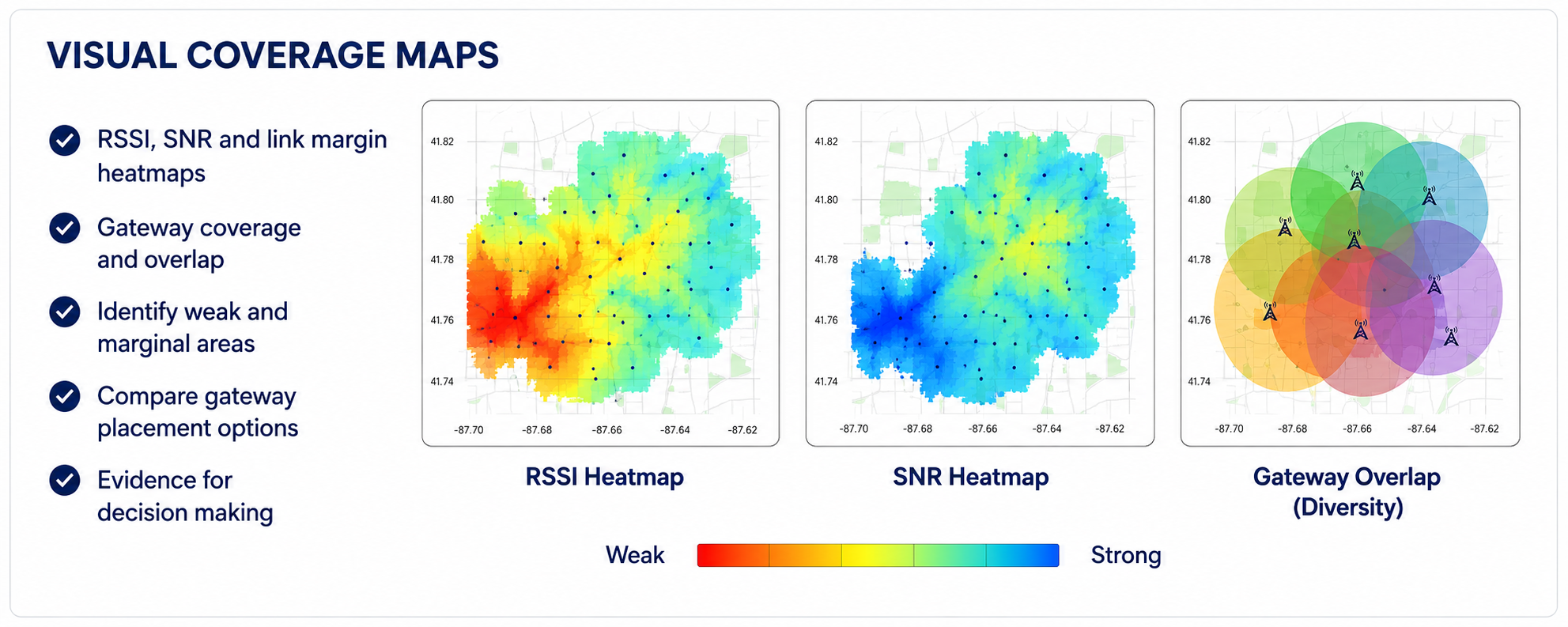
LEVER can use survey data to create advanced LoRaWAN coverage heatmaps illustrating:
- RSSI
- SNR
- link margins
- gateway coverage
- gateway overlap
- gateway diversity
- weak coverage areas
- Data Rates
- network capacity.
Results can be presented for individual gateways or as a combined network view.
This can reveal where relatively small changes to gateway placement could produce disproportionately large improvements in network performance.
Real-World RF Measurement
LoRaWAN coverage modelling can be extremely useful during the early stages of a project.
But a predictive model remains exactly that: a prediction.

Real buildings contain complicated RF propagation environments that are difficult to model accurately.
Reinforced concrete, steel structures, foil-backed insulation, machinery, plant, storage racks, glazing and underground areas can significantly alter radio propagation.
LEVER therefore uses predictive modelling where appropriate, but complements predictive LoRaWAN design with detailed real-world RF measurements.
The combination provides a far more reliable basis for LoRaWAN network engineering.
RF Spectrum Analysis
LoRaWAN normally operates in licence-exempt radio spectrum.
Where appropriate, LEVER LoRaWAN surveys include RF spectrum analysis to identify potential interference or unusually high RF utilisation.
Spectrum analysis may reveal:
- persistent transmitters
- intermittent interference
- elevated noise levels
- unexpected radio systems
- heavily occupied frequencies.
LoRaWAN Validation Survey
Surveying is not only useful before installation.
For LoRaWAN networks that have been deployed, LEVER’s post-installation LoRaWAN validation surveys evaluate existing LoRaWAN networks against your coverage, capacity and resilience requirements.
Validation can include:
- coverage testing
- RSSI and SNR measurements
- identification of marginal locations
- gateway diversity assessment
- uplink and downlink testing
- interference investigation
- confirmation of gateway locations.
LoRaWAN Troubleshooting Surveys
Poor LoRaWAN communications may be caused by failures in RF coverage, but this is far from the only possibility.
LEVER can investigate issues including:
- poor sensor antenna placement
- metal enclosures
- inappropriate gateway locations
- antenna or feeder problems
- interference
- incorrect radio configuration
- spreading-factor issues
- Adaptive Data Rate behaviour
- gateway problems
- Network Server configuration
- excessive downlink traffic
- application or integration problems.
Our expertise extends beyond RF surveying into the complete LoRaWAN architecture, allowing us to distinguish genuine coverage problems from network, server or application issues.
Typical LoRaWAN Survey Environments
We survey most LoRaWAN operating environments, including:
- commercial buildings
- industrial sites
- manufacturing facilities
- warehouses and distribution centres
- hospitals
- universities
- business campuses
- historic and heritage buildings
- utilities
- smart buildings
- agricultural sites
- outdoor infrastructure.
LoRaWAN Survey Deliverables
Depending upon the project, our survey deliverables can include:
- survey findings and analysis
- coverage maps and heatmaps
- gateway coverage comparisons
- RSSI and SNR measurements
- path-loss data
- assessment of link margins
- gateway diversity analysis
- recommended gateway locations
- identification of weak areas
- RF spectrum findings
- engineering recommendations
- design changes
- post-installation validation results.
The LEVER Difference
There are many reasons why LEVER lead the field.
We are not tied to any gateway or sensor manufacturer, Network Server or IoT platform.
Our wider expertise encompasses RF engineering, Wi-Fi, LoRaWAN, IoT networking, spectrum analysis, packet analysis, network architecture and wireless security.
Professional Wi-Fi surveying has benefited from sophisticated specialist survey tools and methodologies for many years, however LoRaWAN surveying has traditionally been much less developed.
LEVER is working to change that.
Our proprietary, patent-pending LoRaWAN survey technology and methodologies have been developed from decades of practical wireless network engineering experience.
They allow us to evaluate LoRaWAN design and performance in ways that conventional survey techniques cannot achieve.
Talk to LEVER About Your LoRaWAN Survey
Whether you are designing a new LoRaWAN network, deciding where gateways should be located, planning a major IoT rollout, validating an installation or troubleshooting an unreliable network, LEVER can provide an independent, technically rigorous assessment.
Testimonials
Don’t just take our word for it
Case Studies
See how Lever have helped business and organisations with their Wifi installation requirements.
Repair, Installation, Training & Support
Get Started
We’ll find the solution, performance guaranteed.
Get in touch to find out more.